Yacht brokers cite 10 to 15 percent of the purchase price per year as a rule of thumb. Small owner-run yachts often spend less on running costs, large crewed ones rarely do. Which items drive the bill, with reference values from surveys and industry figures.
In short
- Rule of thumb for large yachts: running costs of 10 to 15 percent of the purchase price a year, maintenance alone 5 to 10 percent.
- Berths on the German Baltic coast in 2026: on average €44.50 per square metre and season in Schleswig-Holstein, €38.10 in Mecklenburg-Vorpommern.
- Insurance: 0.5 to 2 percent of the value a year for hull cover, liability costs only a fraction of that.
- From about 24 metres the world of permanent crew begins, and staff become the biggest single item.
The rule of thumb and its limits
Large yacht brokers put the running costs of a yacht at 10 to 15 percent of the purchase price per year. For a €20 million yacht that is €2 to 3 million, every year. The rule comes from the world of superyachts with permanent crew and becomes less precise as boats get smaller. A twelve-metre cruising yacht sailed by its owner has no crew, spends the winter ashore and covers fewer miles. Instead, one item matters a great deal that the rule of thumb leaves out: depreciation. Whoever wants to know what their yacht costs adds up the items one by one.
The berth
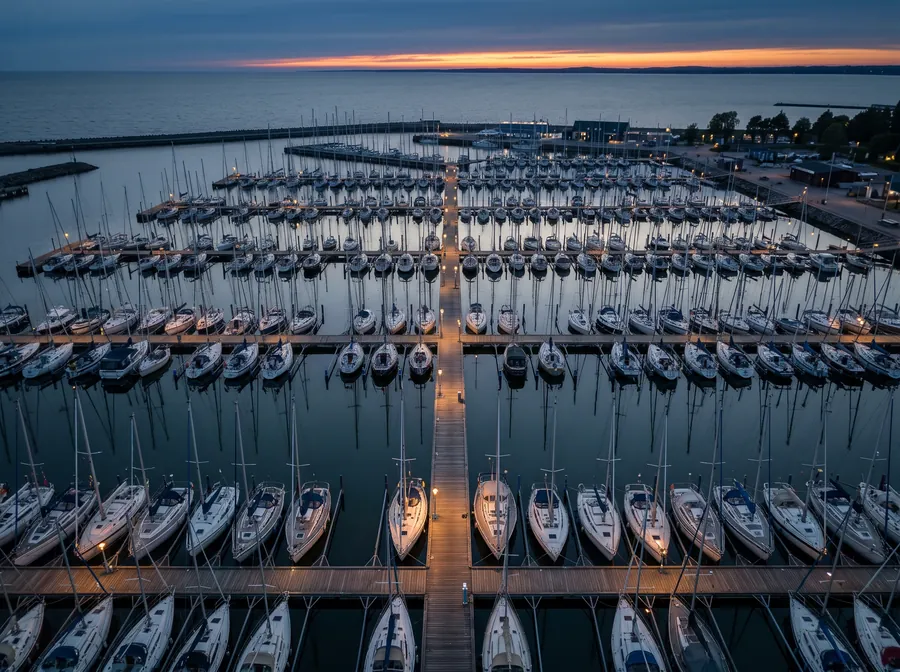
On the German Baltic coast, seasonal berth holders pay on average €44.50 per square metre and season in Schleswig-Holstein in 2026, according to a survey by the German sailing magazine YACHT, with a range of €15 to €76, and €38.10 in Mecklenburg-Vorpommern. The area is length times beam: a yacht of 12 by 4 metres takes up 48 square metres and so costs around €2,100 a season in Schleswig-Holstein and around €1,800 in Mecklenburg-Vorpommern. Space is scarcer than money: 69 percent of the harbours surveyed in Schleswig-Holstein reported no free seasonal berth. Visitors pay around €25 a night there for a twelve-metre yacht. In popular Mediterranean marinas an annual berth costs considerably more; for a 20-metre yacht, yacht advisers quote €10,000 to €20,000 a year.

Insurance
Liability cover is the most important element because it pays for damage to other boats, harbours and people, and it is cheap: pure boat liability policies start at around €50 a year. Hull cover for your own boat depends on the insured value, cruising area, deductible and berth. For large yachts brokers quote 0.5 to 2 percent of the value per year; smaller cruising yachts in the North Sea and Baltic tend to sit at the lower end of that range. An up-to-date valuation survey helps on both sides of the bill: it sets a traceable insured value and avoids arguments about the current value after a loss.
Maintenance, winter storage, repairs
This is where the range is widest. For superyachts, brokers quote 5 to 10 percent of the purchase price for maintenance alone, unplanned repairs come on top, and every five to seven years a major refit is due, one of the most expensive single outlays in a yacht’s life. For an owner-operated 20-metre yacht without crew, yacht advisers reckon with €15,000 to €25,000 of maintenance a year. On smaller boats it is lifting, winter storage, antifouling, engine service, sails and electronics that add up. Part of it can be planned, the rest cannot: a reserve for the unexpected belongs in every honest calculation.
Crew and operation
From 24 metres the industry speaks of large yachts, and this is usually where permanent crew begins. A 40-metre yacht typically has cabins for 10 to 12 guests and a crew of similar size. Mid-size yachts run with eight to fifteen full-time crew whose salaries range from €40,000 to well over €150,000 a year, plus health insurance, training and travel. One example budget for a 30-metre yacht with private crew comes to €300,000 to €500,000 of operating costs a year, of which €180,000 to €250,000 is crew. At 40 metres in commercial operation it is €0.8 to 1.2 million. Fuel varies with use; for the 20-metre yacht without crew, advisers quote €8,000 to €15,000 a year.
Depreciation
According to market observations, new yachts lose around 20 percent in the first year, and some specialist writers speak of up to 30 percent straight after handover. After that it is 5 to 10 percent a year with good care, and production boats lose hardly any value after ten to fifteen years. That makes used yachts financially attractive: the steepest part of the curve has been paid for.
The worked example
A used sailing yacht, 12 by 4 metres, bought for €180,000, kept for eight years, berthed in Schleswig-Holstein. Depreciation at 7 percent a year: around €9,900. Berth: around €2,100. Hull insurance at 1 percent of the average value: around €1,400. Maintenance and winter storage at 3 percent of the purchase price: €5,400. Fuel, fees and odds and ends: €2,500. Interest or lost return of 3 percent on the capital tied up: around €4,200. Together around €25,600 a year or a little over €2,100 a month, about 14 percent of the purchase price. Around €11,400 of that actually leaves your account; the rest sits in depreciation and tied-up capital. The yacht cost calculator shows the figure with your values.
Frequently asked questions
Does the ten percent rule apply to small boats too?
As a rough guide yes, but it comes from the world of large crewed yachts. For small owner-sailed boats, running costs without depreciation are often lower, and with depreciation and the cost of capital often higher. Adding up the items one by one is more precise.
What does a berth on the Baltic cost?
According to a 2026 survey by the sailing magazine YACHT, on average €44.50 per square metre and season in Schleswig-Holstein and €38.10 in Mecklenburg-Vorpommern. For a yacht of 12 by 4 metres that is around €1,800 to €2,100 a season, provided a space is free.
Is a yacht an investment?
As a rule, no. A yacht loses value and costs money every year; it is a piece of quality of life. It is best bought with money that is needed neither for retirement provision nor for the emergency fund.
Share